
Table of Contents
ToggleBy 2026, medical billing automation will no longer be an optional upgrade that any healthcare organization can use if it chooses to, or operate normally without it. Instead, they have become core tools that all institutions must master to properly manage revenue flows and successfully collect all funds owed to them.
In the past, billing staff had to manually enter data line by line from piles of materials, and call insurance providers one by one to verify patients’ reimbursement eligibility. If a submitted reimbursement claim was rejected due to errors, they had to reorganize the materials and resubmit them. All these trivial tasks combined would often take several hours. Today, this work no longer requires human intervention and is instead entirely handled by systems equipped with AI
This shift from fully manual work to humans only assisting AI is far more than just a simple replacement of work tools. It is reshaping the daily work rhythm of all relevant practitioners: whether it is the in-house team dedicated to billing processing, the medical practitioners who see patients in their clinics, or RCM partners that specialize in helping institutions manage their revenue processes, the content and methods of everyone’s daily work have changed along with it.
This article will clearly elaborate on three key points: first, what exactly medical billing automation entails; second, how AI is integrated into every step of the billing process; and third, what healthcare must know before deciding to adopt such an automated system.
What Is Medical Billing Automation?
Medical billing automation refers to the use of software and AI-powered tools to manage repetitive, rules-based tasks in the billing process, things like eligibility checks, claim scrubbing, coding validation, and payment posting, without needing manual intervention at every step.
It’s worth separating basic automation from AI-powered automation, because they’re not the same thing. Basic automation follows fixed rules: if a field is blank, flag it. AI-powered medical billing automation goes further. It learns from historical claims data, recognizes patterns throughout payers, and makes predictive judgments, such as flagging a claim as likely to be denied based on characteristics similar to past denials, even if it doesn’t violate an obvious rule.
This distinction is critically important, as it draws a fundamental difference between two types of automation, one that only helps people speed up the work they are already doing, and another that can proactively block errors, stopping them the moment they are about to emerge.
How Is AI Used in Medical Billing
Today, AI tools for processing medical billing have been integrated into nearly every link of the revenue recovery process. And this type of AI used in medical billing is generally divided into several core categories:
Predictive analytics:
Scores each claim for denial risk before it’s ever submitted
Natural language processing (NLP):
Reads clinical documentation and pulls out the correct codes
Machine learning models:
Learn how individual payers behave over time and adjust claim scrubbing rules to match
Robotic process automation (RPA):
Handles repetitive tasks like payment posting and eligibility verification
The common thread across all of these is that AI in medical billing isn’t a single tool; it’s a layer applied across existing billing workflows to reduce manual touchpoints and catch problems earlier in the process.
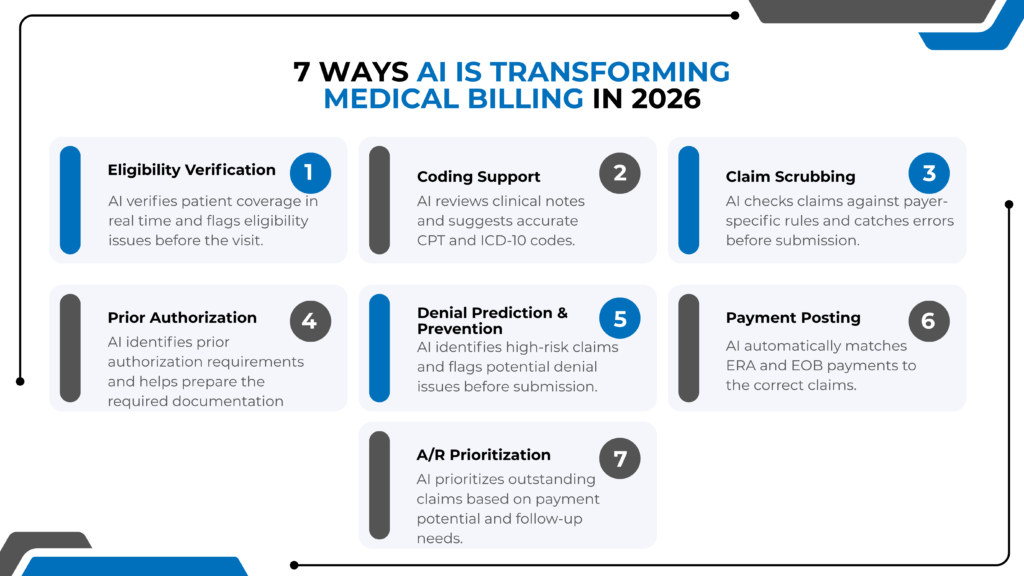
7 Ways AI Is Transforming Medical Billing in 2026
This is where medical billing automation shows up most concretely, across seven parts of the billing workflow.
1. Eligibility Verification
AI-powered eligibility tools check patient coverage in real time before a visit, flagging inactive policies or coverage gaps that would otherwise result in a denial. This is one of the earliest and most effective points of automated medical billing.
2. Coding Support
NLP-based coding assistants scan clinical notes and suggest CPT and ICD-10 codes that align with the documentation, reducing the risk of undercoding and overcoding before a claim is even built.
3. Claim scrubbing
Before each claims application is formally submitted to the payer, it will go through this automated verification process. In this process, the application content will be checked and verified individually against the payer’s exclusive rules. Most of the hidden, seemingly insignificant flaws in the application can be spotted at this stage; if they are not detected and the application is sent out as is, these small issues will eventually significantly slow down the entire claims process.
4. Prior Authorization
Figuring out which services require prior auth and which payer they apply to has always eaten up billing staff time. AI tools can flag that requirement automatically and, in some cases, even pull together the documentation needed to submit it, so the request doesn’t sit in a queue for days.
5. Denial Prediction and Prevention
This is probably where AI earns its keep the most. By looking at historical claims data, models can spot claims that resemble those previously denied, tied to a specific payer, provider, or code pairing, and flag them before they’re ever submitted.
6. Payment Posting
7. A/R Prioritization
Most past processes for handling accounts receivable were sorted by storage order, and the oldest claims application was always processed first. AI overturned this old logic: it will re-sort all pending claims applications, with the core basis for the sorting being the probability of successful payment collection for each application in the end.
As a result, the team responsible for reconciliation no longer needs to process items one by one in chronological order and can instead spend the time and energy saved on the accounts that truly require follow-up and payment collection.
Together, these seven areas represent the practical core of medical billing automation in 2026.
How AI Is Transforming Revenue Cycle Management
Zooming out from individual tasks, healthcare revenue cycle automation is changing how the entire billing operation functions. Revenue cycle automation connects the front end (scheduling, eligibility) to the back end (payment posting, A/R) through a continuous data flow, rather than a series of disconnected manual steps.
This matters because revenue cycle bottlenecks often occur at handoff points, such as when eligibility data doesn’t reach the coding team or a denial reason isn’t logged in a way the A/R team can act on. AI-powered automation helps prevent such gaps by keeping information consistent and making sure flagged issues remain visible throughout the billing process.
How AI Helps Reduce Medical Billing Errors
AI models can cross-reference every single claim in real time against tens of thousands of historical claims, as well as the individual rules set by each payer. This process is impossible for any human reviewer to match in both processing speed and scale of coverage.
Even the most experienced veteran employees cannot remember the details of thousands of previously rejected claims at once, let alone memorize the specific requirements of every single payer.
If the characteristics of a new claim overlap with those of a previously rejected claim, the model will flag it directly to prompt a human review rather than submit it as-is. A person can then double check it, fix the issues, and only then send it out.
Benefits of Medical Billing Automation for Healthcare Providers
For healthcare providers, the real benefits of medical billing automation come down to a few consistent outcomes:
- Less manual work across eligibility checks, coding validation, and payment posting
- Fewer preventable errors caught prior to submission instead of after denial.
- Faster workflows from patient intake through reimbursement
- Improved staff productivity, since billing teams spend less time on repetitive tasks and more on complex claims and appeals
- Cleaner claims, which directly improves first-pass acceptance rates
- Better revenue visibility, with real-time flagging instead of end-of-month surprises
These benefits compound over time. A practice that reduces denials by catching mistakes early also reduces the downstream cost of rework, appeals, and delayed cash flow.
Will AI Replace Medical Billers?
The answer is no. Current AI can only take over the repetitive, rule-based parts of this job and automate those segments. It cannot replace the judgment that senior billers apply in their work. Long-tenured veteran employees can handle all kinds of unexpected, special situations based on accumulated experience, and this is a capability AI cannot learn, nor can it take it away.
What is truly changing is the content of the job itself. In the past, medical billers had to spend a large amount of time every day manually entering various types of information into the system and repeatedly cross-checking it against source materials, terrified of making even a single mistake. Now, most of these tasks are handled by AI, and the time they spend on this work has steadily decreased.
The time they save is mostly spent handling the special cases AI flags those claims that cannot be verified solely by fixed rules, and require a real person to make a decision before the process can move forward. To achieve the best results from medical billing automation, you must combine the efficiency of AI with the oversight of senior staff. Organizations that seek to remove humans entirely from the process and rely solely on AI to handle all tasks will never achieve this level of quality.
Risks and Limitations of AI in Medical Billing
Medical billing automation isn’t risk-free, and providers should go in aware of the limitations:
- HIPAA and data privacy: Any AI tool that handles PHI must comply with HIPAA standards, including encryption and access controls. Not every vendor meets this bar.
- Data quality dependency: AI models are only as good as the data they’re trained on. Poor historical data may result in inaccurate denial predictions or coding suggestions.
- Inaccurate recommendations: AI coding and denial predictions are suggestions, not final decisions. Without human review, errors can slip through just as easily as they were caught.
- Integration obstacles: AI tools need to connect cleanly with existing EHR and practice management systems. Poor integration can create new data gaps instead of closing them.
- Over-reliance risk: Removing human monitoring entirely increases exposure to both compliance and regulatory issues
None of these are reasons to avoid automation in medical billing, but they are reasons to implement it with proper vendor vetting and continued staff oversight.
The Future of AI and Medical Billing Automation
Heading further into 2026 and beyond, medical billing automation is moving toward tighter integration across the entire revenue cycle, from real-time eligibility at scheduling to predictive A/R prioritization on the back end.
The practices and RCM partners seeing the strongest results are the ones treating AI as a layer across the entire workflow, not as a single-point tool bolted onto one part of the process.
As payer rules and documentation rules continue to evolve, the providers best positioned to keep up will be those using AI for medical billing to catch issues early, rather than relying on manual review to catch what’s already gone wrong.
Frequently Asked Questions
Can AI help with medical billing?
Yes. AI is used across eligibility verification, coding support, claim scrubbing, denial prediction, payment posting, and A/R prioritization to reduce manual work and catch errors before claims are submitted.
Can medical billing be automated?
Yes, many medical billing tasks can now be automated, including eligibility checks, claim scrubbing, and payment posting. Complex judgment calls, appeals, and payer negotiations still require human review.
How does AI reduce medical billing errors?
AI compares claims against historical data and payer-specific rules to flag expected errors, like mismatched codes or missing modifiers, prior to submission rather than after a denial.
Is medical billing automation HIPAA compliant?
Reputable automation platforms are built to meet HIPAA requirements, including data encryption and access controls. Providers should confirm compliance approvals before adopting any new tool.
How much does medical billing automation cost to implement?
Costs vary widely depending on whether a provider builds internal tools or partners with an RCM provider that already has automation in place, the latter being the faster, lower-risk option for most practices.