

Table of Contents
ToggleRevenue cycle optimization starts with a simple question most practices never ask: where is the money actually going?
Your practice may be seeing more patients, submitting claims on time, and receiving payments every day.
But even with all that, you may still be collecting less than you should.
If claims are going out and payments are coming in, where is the revenue actually going?
The reality is that revenue loss usually isn’t caused by one big event. Instead, it adds up slowly through small problems throughout the revenue cycle.
The Revenue You Earn Is Not Always the Revenue You Collect
Many practices think revenue loss occurs only because of unpaid claims, large denials, or patients who don’t pay.
But money can still be lost even when claims are processed and payments are coming in.
Sometimes services aren’t billed, claims are underpaid, or missing authorizations put payments at risk. Small coding mistakes can reduce your earnings, and old claims get harder to collect over time.
That’s why improving your revenue cycle is so important. It’s not just about going after bigger claims, but about finding and fixing small leaks before they become a bigger problem.
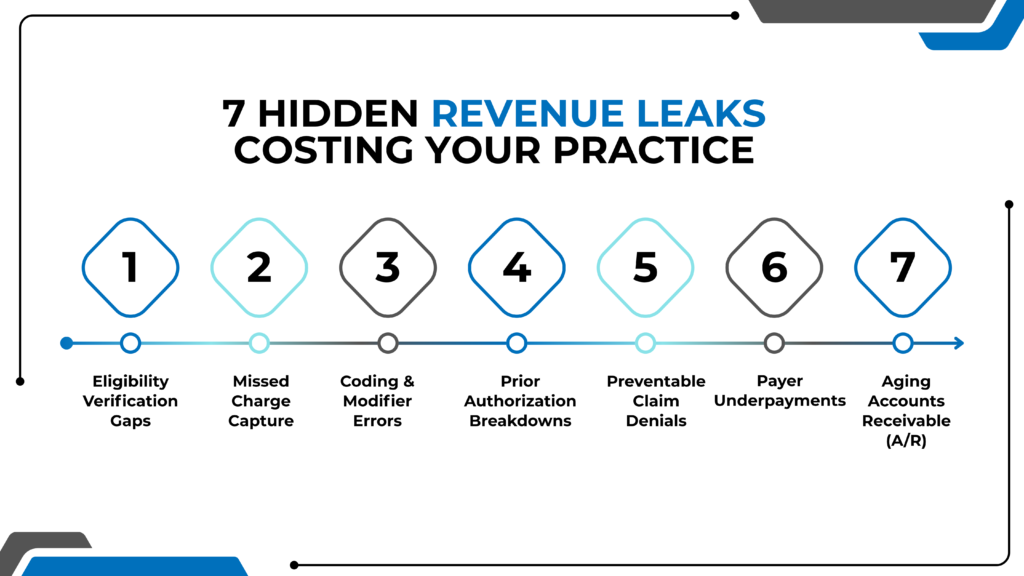
To see where your revenue is going, you need to track it through each step of the revenue cycle. There are seven key areas to check.
7 Hidden Revenue Leaks Draining Your Medical Practice
1. Eligibility Gaps That Put Revenue at Risk Before the Visit
Revenue loss can begin even before the patient meets the provider.
If the front desk misses an eligibility check, it can result in a claim being denied weeks later. What seems like a small front-office mistake can turn into a bigger revenue issue.
2. Services Delivered but Never Fully Charged
Your team did the work. The patient got the care.
But sometimes, part of the service doesn’t make it onto the bill between the visit and the claim. That means you’re missing out on revenue without even realizing it.
3. Coding and Modifier Errors That Quietly Reduce Reimbursement
Not all coding mistakes cause a denial. Some just quietly reduce how much you get paid.
If you miss a modifier or use the wrong code, your claim might still go through, but you’ll get paid less than you should, and you might not even notice.
4. Prior Authorization Breakdowns That Surface Too Late
Authorization problems can be frustrating because you often don’t see the financial impact until after care has already been provided.
By the time you get a denial, the service is finished, and the cost is already yours to bear.
6. Payer Underpayments That Look Like Successful Claims
This is one of the hardest leaks to spot.
The claim wasn’t denied; it was paid. But it wasn’t paid the right amount. Everything looks fine on paper, but you’re actually losing money with each of these claims.
7. Aging A/R That Quietly Loses Collectibility
The longer a balance goes unpaid, the harder it is to collect.
Aging accounts receivable don’t stand out; they just quietly become harder to recover over time.
Why These Revenue Leaks Are So Easy to Miss
If these issues cost so much, why aren’t they noticed earlier?
It’s because revenue loss in healthcare is spread out across many areas.
An eligibility problem might start at the front desk. Coding issues can happen during claim preparation. Denials might not appear until weeks later. Underpayments can look like full payments. Unresolved balances can get lost in aging reports that aren’t reviewed closely.
Each department only sees part of the process. Leadership sees the money coming in, but often doesn’t realize what was never collected at all.
This disconnect is why revenue loss in healthcare often goes unnoticed for so long.
Finding the Leaks Starts With the Right Revenue Cycle Metrics
Once you know what to look for, the next step is to measure the right areas.
Here are the key things to check:
1. Denial rate:
Are denials increasing, and which reasons keep repeating?
2. First-pass claim performance:
How many claims need correction or rework before they’re paid?
3. Days in A/R:
How long does earned revenue sit outstanding?
4. A/R aging:
How much is sitting beyond 30, 60, 90, or 120 days?
5. Charge lag:
How long is the lag between the service and the charge entry?
6. Authorization related denials:
Are front-end authorization gaps repeatedly reaching billing?
7. Underpayment variance:
Are payer reimbursements matching contracted rates?
8. Write-offs:
Why is revenue being written off in the first place?
These metrics alone won’t solve the problem, but they will show you exactly where to begin.
Revenue Cycle Optimization Means Fixing the Source, Not the Symptom
Here’s the change in thinking that really makes a difference.
A strong revenue cycle doesn’t just fix errors quickly; it helps prevent them from happening in the first place.
Repeated eligibility denials? Don’t just correct and resubmit. Look at the verification process itself.
Repeated coding denials? Don’t just fix the code. Find out why the same coding issue keeps happening.
Recurring underpayments? Don’t just post whatever the payer sends. Investigate the variance.
Old A/R? Don’t just add more follow-up calls. Figure out why claims keep landing in those aging buckets to begin with.
This is what true revenue cycle optimization means. It’s not just about fixing problems after they happen, but about closing the gaps that cause them in the first place.
The Bottom Line
Your practice likely isn’t having trouble bringing in revenue.
The real challenge is keeping the revenue you’ve already earned.
Too much of your revenue is lost between the patient visit and the final payment due to eligibility gaps, coding errors, authorization delays, denials, underpayments, and old accounts receivable.
True revenue cycle optimization means identifying where losses occur, understanding why they persist, and fixing your workflow so you don’t lose the same revenue again next month.
If you’re ready to find out exactly where your revenue is leaking, MedBill RCM can help you track it down, step by step.
Frequently Asked Questions
1. What is revenue cycle optimization?
Revenue cycle optimization is the process of improving financial workflows from patient registration through final payment to reduce delays, prevent revenue loss, and improve collections.
2. What causes revenue leakage in healthcare?
Healthcare revenue leakage can result from eligibility errors, missed charges, coding issues, authorization failures, claim denials, payer underpayments, and unresolved accounts receivable.
3. What are the most common denials in medical billing?
Common medical billing denials include eligibility issues, missing prior authorization, coding or modifier errors, duplicate claims, missing information, and lack of medical necessity.
4. What are the different types of denials in medical billing?
Medical billing denials commonly involve eligibility, authorization, coding, documentation, timely filing, medical necessity, and coordination of benefits.
5. How can a medical practice identify revenue leaks?
Practices can identify revenue leaks by monitoring denial trends, charge lag, days in A/R, aging balances, write-offs, underpayments, and recurring eligibility or authorization issues.
6. How can healthcare providers improve revenue cycle performance?
Providers can improve revenue cycle performance by strengthening front-end verification, improving charge capture and coding accuracy, preventing recurring denials, monitoring payer payments, and consistently following up on outstanding A/R.