
Table of Contents
ToggleHome care revenue cycle management begins long before a claim reaches the payer. An authorization is approved, a caregiver completes the visit, and the agency expects payment.
Then the billing team discovers a problem.
The delivered hours exceed the available authorization units. The electronic visit verification record contains an unresolved exception. Or the claim lists a service code that does not match the approved service.
The agency provided care, but the claim cannot move forward without further review.
These situations highlight a very expensive weakness in the home care revenue cycle: authorisation approval does not in any way guarantee that the reimbursement will follow.
For a Medicaid-funded home care agency, the revenue stream depends on what happens between approval, scheduling, service delivery, visit verification, and billing.
Understanding where those processes break down can help agencies avoid delays, reduce admin, and protect revenue.
Why an Approved Authorization Does Not Guarantee Payment
Authorization confirms that the payer has approved the stated services subject to the applicable conditions.
It doesn’t automatically mean that every subsequent visit will meet the criteria for reimbursement.
Home care billing teams must consider several factors:
- Whether the service occurred within the authorized dates.
- Whether the service delivered is the service approved.
- Whether sufficient authorization units are still available.
- Whether the required electronic visit verification information is complete.
- Whether the claim is a true and accurate reflection of the service actually delivered and documented.
- Whether other eligibility, provider, and payer requirements are met.
A claim can encounter problems even when the original authorization remains valid.
Texas Medicaid provides a useful example.
Its EVV claims process involves comparing the submitted claim data against the accepted visit transactions. The elements that are compared are: member ID, service dates, provider, service codes, modifiers, and billable units.
Texas also makes an important distinction: a successful EVV match does not guarantee payment.
A payer can still refuse a claim if other requirements aren’t met (for example, if the amount billed exceeds the authorized amount).
This is why home care revenue cycle management has to go beyond just getting approvals.
Agencies need a robust process in place to ensure that authorised care is properly documented, verified, and billable.
Where Revenue Gets Stuck Between Authorization and Billing
Revenue problems don’t usually start when a claim is denied.
They tend to develop earlier as information flows among the authorisation coordinators, schedulers, caregivers, EVV systems, and billing teams.
Consider a typical Medicaid personal care workflow.
Authorization approved → Visit scheduled → Service delivered → EVV completed → Documentation reviewed → Claim submitted → Payment processed
Each stage depends on accurate information from the previous stage.
An authorisation co-ordinator may receive an updated approval, but the scheduling team will still be working off the old service limits.
A caregiver may complete a visit, but the EVV system records an incorrect duration.
A billing specialist could well submit the authorised service code without realising that the service actually delivered had been documented differently.
These gaps can create payment delays, claim corrections, denials, or unrecoverable charges.
The solution begins with identifying where the information stopped matching.
Five Ways Authorized Home Care Visits Become Unbillable
Not every billing issue will lead to a permanent loss of revenue.
Some discrepancies can be corrected before submission. Others require payer clarification, claim adjustments, or additional documentation.
Some services may in the end remain ineligible for reimbursement.
The following five problems deserve particular attention.
1. Services Fall Outside Authorization Dates
Authorizations generally apply to specific periods.
An agency may carry on with scheduling visits after an approval has expired and/or prior to a new authorisation coming into effect.
Example:
A caregiver completes a visit after the previous authorization period ends.
The billing team later discovers that the new approval does not cover that service date.
The agency will have to decide whether another valid authorization applies or whether the payer allows an appropriate correction.
A completed visit alone does not establish payment eligibility.
Prevention: Check authorization expiry dates prior to scheduling and have a clear process in place for escalation to renew.
2. Delivered Hours Exceed Authorized Units
An authorization may approve a limited number of service units.
Those units must be interpreted in accordance with the applicable program and payer rules.
For example, a payer may define one billing unit as a specific increment of service time.
An agency that schedules more care than the remaining authorization permits can create a reimbursement problem.
Example:
A member has four authorized service hours remaining.
The agency schedules and delivers five hours without confirming additional approval.
The billing team is responsible for reconciling actual service, the authorization balance, and applicable payer requirements.
The extra hour may not qualify for reimbursement.
Prevention: Track remaining authorization units alongside scheduled and completed visits.
This is particularly important when multiple caregivers serve the same member.
3. Prior Authorization Requirement Detection Tools
Authorization records may specify particular service codes or modifiers.
Claims must use codes that accurately represent the delivered service and satisfy payer requirements.
A mismatch will stop a claim being validated.
Texas Medicaid identifies service code and modifier mismatches as an EVV claim matching issue.
Example:
An authorization covers one personal care service.
The claim contains a different service code that does not match the accepted EVV transaction.
The claim fails the relevant matching process.
Staff must investigate the authorization, visit record, and claim before making a supported correction.
Prevention: Validate service codes and modifiers across authorization, scheduling, EVV, and billing records.
4. EVV Records Are Missing or Incomplete
Electronic visit verification is used to document the Medicaid funded services which require an in-home visit.
Under federal requirements, applicable EVV systems capture six elements:
- Type of service performed.
- Individual receiving the service.
- Individual providing the service.
- Date of service.
- Location of service delivery.
- Time the service begins and ends.
Missing or inconsistent information can lead to billing problems.
For example, a caregiver may forget to complete an EVV check-out.
The visit record may then need to be investigated and appropriately corrected.
Prevention: Review unresolved EVV exceptions promptly rather than waiting until claim submission.
5. Delivered Care and Billing Documentation Do Not Agree
EVV confirms required visit information, but it does not replace all clinical or service documentation.
Agencies may require additional records to support the services they bill.
Problems occur when the visit notes, the service records, the authorisations and the claims all contain contradictory information.
Example:
The EVV record shows a completed visit.
However, the accompanying service documentation does not adequately support the service units proposed for billing.
The billing team requests clarification before submitting the claim.
Prevention: put in place documentation checks that flag missing or contradictory information whilst staff are still investigating the visit.
How EVV Discrepancies Affect Home Care Billing
Electronic visit verification is a critical part of Medicaid home care administration.
The 21st Century Cures Act set the EVV requirements for applicable Medicaid personal care and home health services that involve in-home visits.
However, federal requirements do not create one identical claims process for every state.
States and payers all have their own operational procedures, their own validation rules and their own correction processes.
Understanding those differences is absolutely critical to home care revenue cycle management.
Texas: EVV Claims Must Match Accepted Visit Records
Texas Medicaid requires claims for EVV-covered services to match accepted visit transactions before reimbursement.
Its claim-matching process identifies several potential discrepancies.
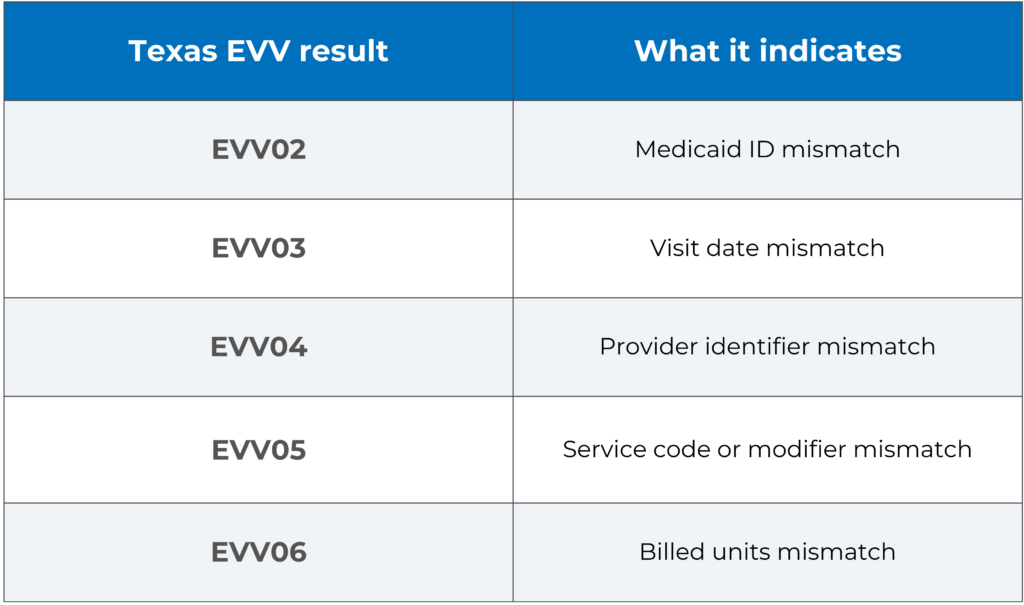
These results help agencies identify why a claim failed EVV matching.
The billing team can then investigate the underlying records and determine the appropriate next action.
Crucially agencies must not change legitimate service information just to get a claim to validate.
North Carolina: Missing EVV Can Delay or Reduce Payment
North Carolina Medicaid provides another example.
Its EVV claim processing rules contain two relevant edits.
Edit 02077: EVV Not on File
An applicable claim line without the required EVV information can pend for 14 days before denial.
Edit 02079: Submitted Units Exceed Verified Units
An applicable claim line can pend for seven days before billed units are reduced to the verified amount.
These examples demonstrate two different financial consequences.
One issue will prevent payment until the required visit information is resolved.
Another could result in payment for fewer units than the agency was originally billed.
Neither example implies that every EVV discrepancy results in permanent revenue loss.
Agencies should investigate the reason, correct verified errors, and follow the applicable state’s procedures.
The Financial Cost of Authorization to Billing Gaps
Revenue leakage is not always visible as a denied claim.
Sometimes the agency fails to submit the service for billing.
In other instances, the payer processes fewer units than the agency had anticipated.
Some claims remain unpaid while staff investigates missing documentation or EVV discrepancies.
These situations have different financial consequences.
Delayed Revenue
A correctable issue may postpone claim submission or payment.
The agency may end up with the full amount but the delay in receipt will still have an impact on cash flow.
Reduced Reimbursement
A payer may reimburse fewer units than originally billed when applicable rules support that adjustment.
The agency must determine whether the reduction reflects an error or a legitimate payment limitation.
Unrecoverable Revenue
Some of the services provided may fall outside the scope of valid authorisation or other payment requirements.
When the payer does not permit reimbursement, the agency may have to absorb the associated cost.
Additional Administrative Expense
Even the recoverable claims take up staff time.
Repeated calls, documentation reviews, EVV corrections, and resubmissions increase the cost of collecting payment.
Home care revenue cycle management should measure those impacts separately.
Otherwise, agencies may underestimate the financial impact of operational problems that never appear in denial reports.
How to Prevent Revenue Leakage Before Claim Submission
Preventing unbillable visits requires coordination right through the whole service delivery process.
The most effective controls begin before the caregiver arrives.
Step 1: Verify Authorization Before Scheduling
Confirm the member, payer, approved service, authorization period, provider requirements, and available units.
Check the authorisation info matches what the scheduling and billing teams are working off.
Resolve discrepancies before assigning visits whenever possible.
Step 2: Monitor Authorization Utilization
Compare approved units against scheduled and completed services.
Identify authorizations approaching expiration or exhaustion.
Investigate unusual differences between approved care and actual utilization.
This process can help agencies avoid unsupported scheduling while identifying authorized care that remains undelivered.
Step 3: Review EVV Exceptions After Service Delivery
Monitor visits with missing check-ins, incomplete check-outs, conflicting times, or other unresolved exceptions.
Assign each issue to the appropriate reviewer.
Use the applicable correction process and preserve accurate records of the services delivered.
Step 4: Reconcile Authorization, EVV, and Billing Data
Before submitting claims, compare the information used throughout the workflow.
A practical reconciliation should confirm:
- Member and payer information.
- Authorization dates and remaining units.
- Service codes and modifiers.
- Delivered visit dates and durations.
- Accepted EVV transactions where required.
- Supporting documentation.
- Proposed claim units.
Do not assume that an accepted EVV transaction establishes compliance with every other billing requirement.
Step 5: Investigate Exceptions Before They Become Denials
Create a work queue for unresolved authorization, documentation, and EVV issues.
Each item should identify the problem, the responsible person, the required action, and the follow-up status.
Billing staff should receive confirmation when an issue has been resolved.
This approach helps prevent the same discrepancy from moving repeatedly between departments.
Who Should Own Each Authorization to Billing Exception?
Technology can identify discrepancies, but staff must know who is responsible for resolving them.
A practical division of responsibilities may look like this:
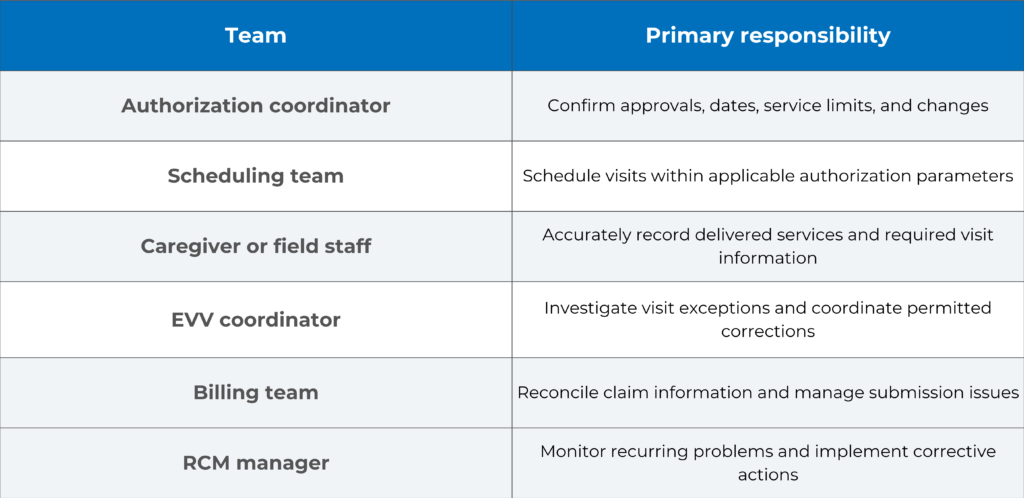
Responsibilities may differ by agency.
What matters is that every exception has a clear owner.
An alert without an assigned action does little to protect revenue.
Metrics Every Home Care Agency Should Track
Home care revenue cycle management requires visibility into problems that occur before claims reach the payer.
Traditional denial reports cannot capture every missed billing opportunity.
Agencies should monitor both operational and financial indicators.
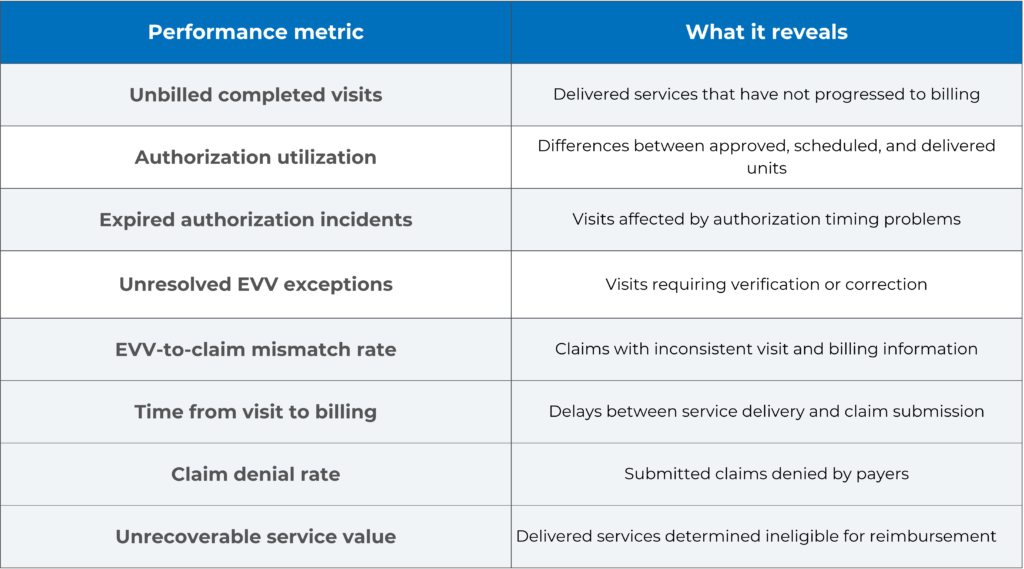
Agencies should define each measure consistently.
For example, an unbilled completed visit may be awaiting normal documentation rather than representing lost revenue.
Similarly, unused authorization units do not automatically represent missed revenue.
Care may not have been delivered because of changing patient needs, cancellations, or other legitimate reasons.
The purpose of these metrics is to identify issues requiring investigation, not assume every difference represents a financial loss.
Protect Revenue Before It Reaches the Claim
An approved authorization is the beginning of a billable service workflow, not the end.
Home care agencies must still ensure that scheduling, service delivery, visit verification, documentation, and claims align with applicable requirements.
When those processes disconnect, agencies may face delayed payment, reduced reimbursement, administrative rework, or unrecoverable service costs.
Effective home care revenue cycle management identifies those risks before they become recurring billing problems.
The goal is not simply to submit more claims.
It is to ensure that properly delivered and documented services move through the revenue cycle with fewer preventable interruptions.
MedBill RCM supports healthcare providers with medical billing and revenue cycle management services focused on billing accuracy, reimbursement challenges, and operational efficiency.
Contact MedBill RCM to discuss how stronger billing workflows can help your agency identify and address revenue cycle gaps.
Frequently Asked Questions
How Do Home Care Agencies Get Paid?
Medicaid-funded home care agencies generally receive payment by submitting claims for covered services that meet applicable program and payer requirements.
Authorization, service documentation, EVV, and claim validation may all affect reimbursement.
Payment processes vary by state, Medicaid program, and managed care arrangement.
Why Can an Authorized Home Care Visit Become Unbillable?
A visit may become temporarily or permanently unbillable if the services delivered do not meet applicable authorization, EVV, documentation, or payer requirements.
Common problems include expired approvals, insufficient units, service-code mismatches, and missing visit records.
How Does Electronic Visit Verification Work?
Electronic visit verification records must contain information regarding applicable in-home Medicaid services.
It identifies the service, recipient, caregiver, date, location, and start and end times.
States use EVV information to support oversight and, where required, claims validation.
How Can Home Care Agencies Prevent Authorization and Billing Mismatches?
Agencies can reconcile authorization details with scheduling, delivered services, EVV transactions, and proposed claims.
They should monitor remaining units, resolve documentation discrepancies, and assign responsibility for exceptions before billing.
How Can Home Care Agencies Optimize Billing?
Agencies can improve home care billing by strengthening authorization tracking, EVV exception management, documentation review, and pre-billing reconciliation.
They should also monitor unbilled visits, claim denials, and recurring workflow problems.
These controls can help identify preventable delays and improve billing accuracy.