
Table of Contents
ToggleHealthcare organizations often use medical billing and revenue cycle management interchangeably. However, each function manages a different scope of the healthcare financial process.
Understanding medical billing vs revenue cycle management helps practices identify where revenue problems originate and determine whether billing support alone can address them.
Medical billing primarily manages claims and payments. Revenue cycle management connects the broader financial journey, from patient access and insurance verification through reimbursement and account resolution.
HFMA describes the healthcare revenue cycle as the processes that track patient revenue from the initial appointment or encounter through final payment.
Medical Billing vs Revenue Cycle Management: The Short Answer
The simplest way to understand medical billing vs revenue cycle management is to compare their scope.
Medical billing teams prepare claims, submit them to payers, monitor payer responses, post payments, resolve claim issues, and track outstanding balances.
Revenue cycle management takes a broader approach. RCM connects the administrative, clinical, and financial processes that influence how accurately and efficiently healthcare organizations receive payment.
Medical billing functions as a critical component of the broader revenue cycle.
This distinction matters because many reimbursement problems begin before a billing team prepares or submits a claim.
What Is Medical Billing?
Medical billing manages the processes healthcare organizations use to bill payers and patients for services and pursue appropriate reimbursement.
After providers document services and coders assign appropriate codes, billing teams use that information to prepare and submit claims in accordance with payer requirements.
Depending on the practice and service arrangement, medical billing teams may manage:
- Claim preparation and submission
- Claim status monitoring
- Payment posting
- Claim rejection correction
- Denial follow-up
- Accounts receivable follow-up
- Patient statements
- Appeals and resubmissions
Accurate medical billing helps practices move services from clinical documentation toward reimbursement.
However, billing teams rely heavily on information collected earlier in the patient journey by other teams.
Incorrect demographics, inactive coverage, missing authorization, incomplete documentation, or coding errors can create problems after a claim reaches the payer.
This upstream dependency creates one of the most important distinctions in medical billing vs revenue cycle management.
What Is Revenue Cycle Management?
Revenue cycle management coordinates the financial processes that surround healthcare delivery.
The process connects patient access, insurance information, clinical documentation, coding, billing, payer reimbursement, patient financial responsibility, and account resolution.
In practical terms, RCM in medical billing connects front-end operations with clinical, billing, and financial teams throughout the reimbursement journey.
Healthcare organizations may include these functions within their RCM workflows:
- Patient scheduling and registration
- Eligibility and benefits verification
- Prior authorization
- Financial clearance
- Clinical documentation
- Medical coding
- Charge capture
- Claim preparation and submission
- Payment posting
- Denial management
- Accounts receivable management
- Patient collections
- Financial reporting and analysis
The exact workflow depends on the organization, payer mix, specialty, internal processes, and services the practice manages internally or externally.
Therefore, medical billing vs revenue cycle management involves more than claim submission. The key distinction lies in how much of the financial lifecycle each function manages.
Medical Billing vs Revenue Cycle Management: Key Differences
The following comparison shows how these two approaches differ across important financial functions.
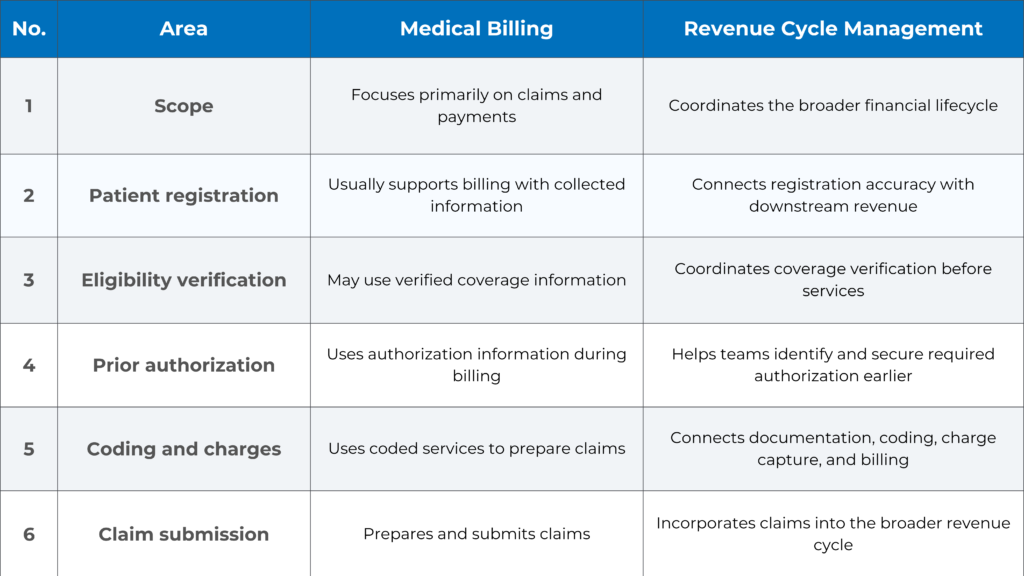
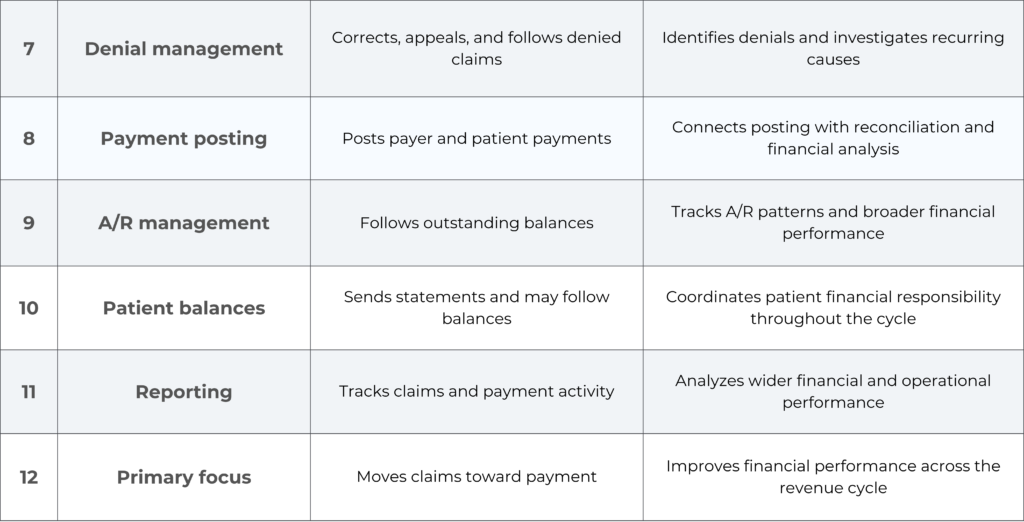
This comparison also explains why practices should not view revenue cycle management and medical billing as two completely separate functions.
Medical billing supports a critical portion of the broader revenue cycle.
Where Does Medical Billing Fit Within the RCM Cycle?
Understanding the RCM cycle in medical billing requires practices to look beyond claim submission.
A simplified revenue cycle follows this path:
Patient Access → Eligibility → Authorization → Documentation → Coding → Charge Capture → Medical Billing → Payment → Denials/A/R → Account Resolution
Each stage creates information or actions that can influence the next stage.
Medical billing plays a major role in claim preparation and submission, payment processing, denial follow-up, and management of outstanding accounts.
However, earlier processes often determine whether billing teams receive accurate information.
For example, staff may collect incorrect insurance information during registration. The billing team may later encounter a rejection even when it prepares the claim correctly.
Likewise, a team that misses required prior authorization can create reimbursement problems before a biller ever submits the claim.
This relationship highlights another important distinction between these two healthcare financial processes.
Medical billing manages claim-focused activities. RCM connects those activities with the upstream and downstream processes that influence financial performance.
Medical Billing Fixes Claims. RCM Identifies Patterns.
Consider a practice that repeatedly receives eligibility-related denials.
Billing teams can investigate individual claims, correct eligibility errors, resubmit claims, and follow payer responses.
An RCM team asks an additional question: Why does the same problem keep reaching the billing stage?
The practice may discover inconsistent insurance verification, inaccurate registration data, or a workflow that fails to identify coverage changes before appointments.
The practice can then strengthen the upstream process and prevent similar problems from reaching the claim submission stage.
This preventive approach creates another meaningful distinction in medical billing vs revenue cycle management.
Billing teams resolve individual claim problems. RCM teams also examine patterns that may reveal weaknesses across the broader financial workflow.
Billing Problem or Revenue Cycle Problem?
Not every reimbursement problem requires a complete revenue cycle overhaul.
Practice leaders should first identify where the problem begins.
A payer may reject a claim if the billing team submits incorrect or incomplete information. In that situation, the practice primarily faces a billing issue.
Repeated eligibility-related denials may point toward problems with registration or insurance verification.
Recurring authorization-related denials may indicate that front-end teams need stronger processes to identify payer requirements before services are provided.
Growing A/R may reflect weak billing follow-up, but practice leaders should also examine denials, payer delays, posting accuracy, patient balances, and account resolution processes.
Examining these functions helps practices understand the broader differences between the two approaches beyond basic claim submission.
It also helps leaders address the root causes of revenue problems rather than repeatedly correcting the same downstream symptoms.
Why the Difference Matters for Healthcare Practices
Understanding medical billing vs revenue cycle management helps healthcare leaders avoid treating every financial problem as a billing problem.
Even a highly capable billing team cannot correct every problem that begins earlier in the patient journey.
Likewise, strong patient-access processes cannot replace accurate coding, claim submission, payment posting, denial follow-up, and A/R management.
Healthcare organizations need these functions to work together.
When teams operate in isolation, errors can move downstream until payers reject claims, delay payments, reduce reimbursement, or leave balances unresolved.
This interconnected workflow highlights how the two processes differ in scope and coordination rather than their overall importance.
Both functions support healthy reimbursement, but RCM connects billing with the wider processes that influence financial outcomes.
Medical Billing vs Revenue Cycle Management: Which Does Your Practice Need?
The answer depends on where your practice encounters financial problems.
A practice with strong registration, authorization, documentation, coding, reporting, and internal financial controls may primarily need specialized medical billing support.
A practice may need broader RCM support when problems consistently appear across several stages of the financial workflow.
Common warning signs include recurring eligibility problems, missing authorizations, frequent denials, aging A/R, inconsistent payment posting, underpayment concerns, or limited financial visibility.
Practice leaders comparing medical billing vs revenue cycle management should evaluate the entire reimbursement journey rather than looking only at claim submission.
They should ask where revenue problems originate, how frequently they occur, and which workflows allow those problems to continue.
Can Better RCM Improve Medical Billing?
Yes. Strong revenue cycle processes can improve the accuracy and completeness of information that reaches billing teams.
Accurate registration gives billing teams reliable demographic and insurance information.
Timely eligibility verification helps staff identify coverage issues before services generate claims.
Effective authorization workflows help teams identify payer requirements before they affect reimbursement.
Complete clinical documentation and accurate coding give billing teams stronger information for claim preparation.
Billing teams can then submit claims, monitor payer responses, post payments, resolve denials, and more effectively follow up on outstanding accounts.
This relationship explains why RCM in medical billing connects multiple financial processes rather than treating each task as an isolated administrative function.
It also reinforces the fundamental difference between these two healthcare financial processes.
Billing manages critical claim and payment functions. RCM coordinates the wider system that supports those functions.
Medical Billing vs Revenue Cycle Management: The Bottom Line
The main difference in medical billing vs revenue cycle management comes down to scope.
Medical billing teams manage essential claim and payment activities. RCM teams connect those activities with the processes that influence revenue before and after billing.
Understanding medical billing vs revenue cycle management helps practices determine whether reimbursement problems originate within claims processing or elsewhere in the revenue cycle.
Instead of focusing only on individual claims, effective RCM examines how registration, eligibility, authorization, documentation, coding, billing, denials, A/R, and payment processes work together.
Healthcare organizations can then identify recurring problems earlier and strengthen the workflows that directly influence reimbursement.
MedBill RCM helps healthcare organizations strengthen the processes that connect patient access, billing, denials, A/R, and reimbursement across the revenue cycle.
Frequently Asked Questions
What is RCM in medical billing?
RCM in medical billing manages the financial processes that connect patient care with reimbursement.
RCM teams coordinate eligibility, authorization, documentation, coding, billing, payment posting, denial management, A/R follow-up, and account resolution throughout the patient financial journey.
What is revenue cycle management in medical billing?
Revenue cycle management connects all financial stages of healthcare delivery, from patient registration and insurance verification to billing, payment collection, and final account resolution.
When comparing medical billing vs revenue cycle management, medical billing manages claims-related activities, while RCM coordinates the broader financial workflow.
What is the revenue cycle in medical billing?
The revenue cycle tracks the financial journey of healthcare services from patient access through final payment.
Healthcare organizations manage eligibility, authorization, documentation, coding, charge capture, claim submission, reimbursement, denials, A/R, and account resolution throughout this cycle.
How does revenue cycle management work?
Revenue cycle management connects patient access, clinical, billing, and financial teams throughout the reimbursement process.
Teams verify coverage, broader authorizations that influence coding, submit claims, post payments, resolve denials, follow outstanding balances, and monitor financial performance.
What is the RCM process in medical billing?
The RCM process starts with patient access and continues through insurance verification, authorization, documentation, coding, billing, payment posting, denial management, A/R follow-up, and account resolution.
RCM teams also analyze financial and operational data to identify recurring issues, reduce preventable delays, and strengthen reimbursement workflows.
Is medical billing part of revenue cycle management?
Yes. Revenue cycle management includes medical billing as a core part of the broader financial process.
When comparing medical billing vs revenue cycle management, medical billing focuses primarily on claims and payments. RCM manages the wider processes that influence reimbursement before and after billing.