
Table of Contents
ToggleTo run a home care agency, you have to coordinate schedules, caregivers, EVV, documentation, compliance, and billing, with the various procedures depending on one another.
Which is why home care scheduling software has evolved into more than just a tool for assigning caregivers to shifts, as agencies now find it necessary for scheduling to integrate with visit verification, documentation, patient information, and administrative workflows.
HHA Exchange has made several updates in 2026 to improve those connections. The most recent ones involve modifications to Visit Maintenance, caregiver visibility, EVV workflows, clinical documentation, and patient record management.
Here is what home care agencies should know about the latest changes and how they may affect their daily operations.
Why Home Care Scheduling Software Matters More in 2026
Scheduling remains one of the biggest operational challenges for home care providers.
The survey conducted by HHAeXchange in 2026 received responses from 465 providers working in the field of home and community-based services. Of the respondents, 44.7% named scheduling as a technology investment area.
The same survey found that 31.9% cited scheduling gaps and call outs as a workforce challenge. Flexible scheduling was also identified by 45.6% as an approach for improving caregiver recruitment and retention.
This helps explain why effective home care scheduling software cannot operate in isolation.
A scheduled visit might also include questions about the caregiver’s eligibility, EVV data, documentation requirements, patient care instructions, authorizations, and information needed later for billing.
Technology investment reflects this broader picture. In the same survey, 63.9% of respondents prioritized EVV and compliance technology, while 38.9% identified billing and payroll.
HHAeXchange’s 2026 updates address several parts of this connected workflow.
What’s new about HHAeXchange in 2026?
Instead of a single major redesign, the recent updates to HHAeXchange have involved numerous workflow changes across agency operations.
Some changes reduce repetitive tasks. Others give agency teams more visibility into visits, caregivers, documentation, and EVV exceptions.
Here are some of the most relevant updates.
Visit Maintenance Makes Exception Management Easier
The August 2026 release included several practical improvements to Visit Maintenance.
Visit Maintenance can now be filtered by team, location, or branch. For EVV exceptions, HHA Exchange has included an All option which enables staff to see all visits that have current EVV exceptions rather than having to select each exception type individually.
Another useful addition is the Reprocess function.
When new EVV information or a system change affects a visit’s exception status, authorized users can trigger a recalculation from Visit Maintenance. This can apply to issues such as late visits, out of window activity, or incorrect caregivers.
HHAeXchange also moved caregiver correction functionality from the Call Dashboard into Visit Maintenance. Caregivers can use the mobile workflow to request corrections to visit times, rather than relying entirely on manual processes.
For agencies, the significance is not simply having more buttons.
These changes bring more exception related tasks into the same workflow. Staff using home care scheduling software and EVV data can spend less time switching between screens to investigate visit issues.
Caregiver Scheduling Gets Better Workflow Visibility
Effective caregiver scheduling software depends on more than knowing whether someone has an open slot.
Agency teams also need context about the caregiver, patient, previous decisions, and potential conflicts.
HHAeXchange’s September release added a history of changes to Declined and Residing Caregivers on the patient profile. This gives authorized users a clearer record of changes instead of only showing the current information.
Conflict Management also received a small but useful workflow improvement.
When staff add notes or send communications from the Conflict Detail page, their selected filters now remain in place. This means users can continue working through a conflict queue without repeatedly rebuilding the same view.
Individually, changes like these may appear minor. In a busy agency handling hundreds or thousands of visits, however, repeated administrative steps can add up quickly.
The direction is important. Modern home care scheduling software needs to give coordinators context around the schedule, not simply display shifts on a calendar.
EVV and Mobile Workflows Continue to Improve
EVV remains closely connected to scheduling because an agency needs to know not only who was scheduled, but also what happened during the actual visit.
HHAeXchange expanded several EVV related workflows during 2026.
The August release added the ability to view all current EVV exceptions together in Visit Maintenance. It also made the Timesheet Required status visible when a visit cannot move through pre-billing until the required paper timesheet is received.
These connections matter because EVV software can affect processes beyond visit verification.
An unresolved exception may require administrative review before a visit can progress through downstream workflows. Giving staff clearer visibility can help them identify where attention is needed.
Mobile workflows are evolving as well.
For example, HHAeXchange added a Plan of Care Note banner to the mobile Duties screen. Caregivers can see patient level care plan notes along with task details such as expected minutes, frequency, and special instructions.
This creates a stronger connection among the schedule, the visit itself, and the information caregivers need to deliver care.
Clinical Documentation Requires Less Repetitive Work
Scheduling a visit is only one part of completing it. Agencies also need accurate documentation around the care provided.
HHAeXchange’s September update introduced multi-submission PDF export for clinical forms.
Agency staff can select clinical documents for one or more patients and process them through a single bulk export request. They can filter documents by patient, date range, type, and status.
Earlier in 2026, HHAeXchange also introduced an auto-populated Plan of Care workflow for clinical forms.
Authorized agency administrators can select an existing Plan of Care associated with a patient and view relevant care plan information directly within the form. The selected Plan of Care remains linked after the form is saved.
That reduces the need to switch between screens to confirm information already in the patient’s record.
For home care agencies, this is an important part of the larger workflow.
Good home care software should reduce unnecessary duplicate entry while keeping scheduling, care delivery, and documentation aligned.
Patient Record Management Gets More Efficient
Duplicate patient records can create administrative problems, particularly when payer relationships or contracts change.
HHAeXchange addressed this with a Bulk Patient Merge Wizard in its August release.
The tool can identify matching patient records and merge them while preserving information such as visit history, schedules, authorizations, and billing records. It can also automate several post merge tasks.
This matters because patient data does not exist separately from scheduling.
Schedules, authorizations, visits, EVV records, and billing information can all depend on the accuracy of the underlying patient record.
For agencies evaluating home care management software, data continuity deserves as much attention as front-end scheduling features.
What These HHAeXchange Updates Mean for Home Care Agencies
The broader story behind these updates is integration.
Home care operations rarely follow a straight line. A schedule change can affect a caregiver. A caregiver issue can affect a visit. A visit exception can affect documentation or pre-billing.
The latest HHAeXchange changes appear designed to reduce some of the friction between these steps.
Less repetitive administrative work: Bulk exports, patient merging, persistent filters, and auto-populated information can reduce the need for repeated data entry and navigation.
Better exception visibility: Visit Maintenance improvements give staff more ways to identify and work through EVV exceptions from a centralized workflow.
Stronger caregiver context: Caregiver history and conflict management changes give coordinators more information while handling patient and scheduling workflows.
Closer field to office connections: Mobile access to care plan information and digital correction workflows help connect what caregivers do in the field with information managed by agency staff.
Not every feature will appear identically for every organization. HHAeXchange is permission-based, and access to specific functions can vary by user role and organization settings.
Agencies should therefore review the functionality available within their own configuration before changing internal processes.
How Key Home Care Workflows Connect
The table below shows why agencies should evaluate scheduling as part of a wider operational workflow.
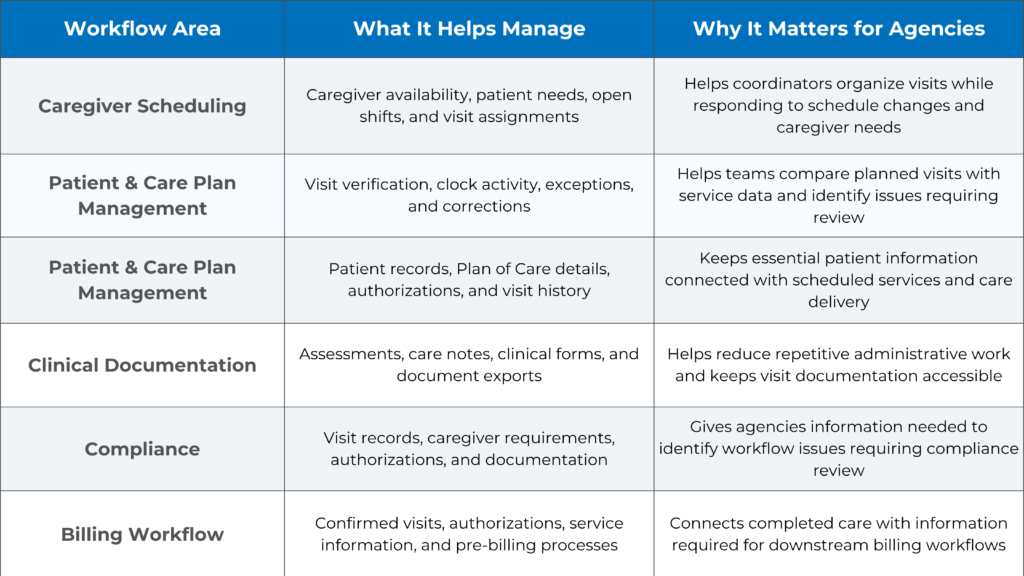
These connections explain why agencies should look beyond individual scheduling features.
A scheduling decision can influence EVV, documentation, compliance, and eventually billing.
Not every HHAeXchange organization will see identical functionality.
HHAeXchange uses role based permissions, so feature access can vary according to user roles and organization settings.
Agencies should review their own configuration before changing internal workflows around a newly released feature.
These connections explain why agencies should look beyond individual scheduling features.
A scheduling decision can influence EVV, documentation, compliance, and eventually billing.
Not every HHAeXchange organization will see identical functionality.
HHAeXchange uses role based permissions, so feature access can vary according to user roles and organization settings.
Agencies should review their own configuration before changing internal workflows around a newly released feature.
What Modern Caregiver Scheduling Software Should Connect
The role of home care scheduling software is expanding.
A basic scheduling system can tell an agency when a caregiver is supposed to arrive. A connected system needs to support the information and workflows surrounding that visit.
That can include caregiver availability and history, patient requirements, authorizations, EVV, visit exceptions, documentation, compliance information, and downstream billing processes.
This is also why caregiver scheduling software and EVV software increasingly need to work together.
Scheduling establishes what should happen. EVV helps document when and where a covered visit occurred, subject to the applicable program and payer requirements.
The administrative workflow then needs to address discrepancies, corrections, documentation, and other exceptions before information moves further downstream.
For agencies comparing home care software, the question is therefore broader than, “Can it build a schedule?”
A more useful question is whether the technology helps staff manage the entire operational workflow associated with that schedule.
Home Care Workflows Are Becoming More Connected
HHAeXchange’s 2026 updates show how home care scheduling software is moving beyond calendar management.
Scheduling now sits within a broader operational environment that includes caregivers, EVV, patient records, documentation, compliance, and billing.
For agencies, the opportunity is not simply to add more technology. It is to reduce the gaps between the systems and processes staff already depend on every day.
As those workflows become more connected, revenue cycle processes need the same attention. MedBill RCM helps healthcare organizations strengthen billing workflows, claims management, and reimbursement processes so operational improvements can carry through to the revenue cycle.
Frequently Asked Questions
What is home care scheduling software?
Home care scheduling software helps agencies organize caregiver assignments, patient visits, schedules, availability, and related operational information.
More advanced platforms can connect scheduling with EVV, caregiver records, visit exceptions, documentation, compliance, and billing-related workflows.
What is HHAeXchange used for?
HHAeXchange provides technology for home and community-based services. Its platform connects providers, caregivers, managed care organizations, and state Medicaid programs across workflows including scheduling, EVV, compliance, and other home care operations.
How does EVV software work with caregiver scheduling?
Caregiver scheduling establishes the planned visit, while EVV software records required information about service delivery.
Connecting the two can help agencies compare scheduled activity with visit data, identify exceptions, and address issues that require administrative review.
What HHAeXchange updates should agencies know about in 2026?
Important 2026 changes include Visit Maintenance improvements, bulk patient merging, caregiver history visibility, Conflict Management enhancements, mobile care plan information, and clinical documentation improvements.
The relevance of each feature depends on an agency’s workflows, permissions, configuration, and applicable program requirements.
What should agencies look for in caregiver scheduling software?
Agencies should consider how caregiver scheduling software handles availability, patient needs, schedule changes, visit exceptions, EVV integration, mobile workflows, documentation, and reporting.
The right capabilities depend on the agency’s services, payer relationships, compliance requirements, and operational structure.