

Table of Contents
ToggleA payment appears on the claim, and the account looks settled. But EOB in medical billing tells only part of the payment story.
The more important question is whether the practice received the reimbursement it actually expected.
A payer may process a claim and make the payment in accordance with its adjudication; however, this does not mean that your team should automatically close the account.
To ensure payment accuracy, attention should be paid to the permitted amounts, adjustments, the patient’s responsibility, the payer’s terms, and the expected reimbursement.
For medical practices, that distinction matters. A claim marked “paid” deserves the same attention as the numbers behind that payment.
What Is an EOB in Medical Billing?
If you want to understand payment accuracy, you first need to know what an EOB is in the context of medical billing and what sort of information it gives.
An Explanation of Benefits, or EOB, shows the way in which a health insurance plan has processed a medical claim.
The CMS states that an explanation of benefits may contain the provider’s charges, the allowed charges, the amount paid by the insurance company, and the patient’s balance.
An EOB is not a bill; rather, it describes the way the insurer has processed the claim and split the financial responsibility.
For practices, EOB in medical billing can provide valuable insight into claim adjudication. However, simply seeing the payment amount should not end the review.
What Your EOB Actually Tells You
Reading an EOB in medical billing requires understanding how several amounts relate to one another.
The billed amount represents what the provider originally charged for the service.
The allowed amount reflects the amount the health plan recognizes under applicable plan terms, negotiated rates, or payment rules.
CMS notes that an allowed amount may also be called an eligible expense, payment allowance, or negotiated rate.
The payer payment shows the amount the insurer paid after applying relevant adjustments and patient responsibility.
The patient responsibility may include deductibles, copayments, coinsurance, or other amounts assigned to the patient under their benefits.
An EOB in medical billing may also contain adjustment or remark information explaining how the payer reached its decision.
Each number provides useful information. The real value comes from understanding how those numbers connect.
The Bigger Question: Was the Claim Paid Correctly?
A payer issued $700. Does that mean $700 was the correct reimbursement?
Not necessarily.
When reviewing an EOB in medical billing, practices should distinguish between receiving a payment and receiving the reimbursement they expected.
This is where medical reimbursement becomes more important than the simple payment status.
Suppose a practice expected $800 based on the applicable reimbursement arrangement, but the payer allowed and paid less.
That difference deserves review.
However, a variance does not automatically prove an underpayment. Contractual adjustments, benefits, patient responsibility, and other adjudication factors may explain it.
Effective healthcare reimbursement review focuses on the reason behind the difference rather than assuming every lower payment represents lost revenue.
An EOB in medical billing provides important clues, but practices still need context to determine whether the payment makes sense.
Allowed Amount vs. Expected Reimbursement: Why the Difference Matters
One of the easiest mistakes is comparing the original charge directly with the payment.
A practice might bill $1,200 and receive $800. That $400 difference does not automatically represent an underpayment.
The billed charge and expected reimbursement serve different purposes.
Expected reimbursement should reflect the applicable payer arrangement, fee schedule, benefit structure, and other factors affecting claim adjudication.
That means practices reviewing EOB in medical billing should focus on what they reasonably expected to receive, not simply what they originally charged.
Consider a simple example.
A provider bills $1,200. The applicable allowed amount is $900, with $100 assigned to patient responsibility and $800 payable by the insurer.
An $800 payment from the insurer may therefore be correct.
But if the applicable reimbursement terms support a different amount, the practice needs to understand why the payer calculated $900 as the allowed amount.
This distinction turns EOB in medical billing from a payment record into a useful starting point for reimbursement analysis.
Where Payment Discrepancies Can Hide
Payment discrepancies do not always show up as clear denials.
A claim can be successfully processed and yet include a variance that deserves to be noted.
Contractual adjustments are one area to review when analyzing EOB in medical billing.
The teams must decide if the payer has applied the adjustment in line with the relevant contract or reimbursement method.
Unexpected adjustment reasons can also change the final payment.
Differences in coding or in the process of adjudication may influence the way the payer handles a service, while an incorrect amount for patient responsibility can cause money to be transferred between the payer’s and the patient’s balances.
There is another possible problem with payment posting.
The account balance or the reimbursement record may still be inaccurate even if the payer sends the right amount.
Recurring differences need special attention.
If the same payer, service, or procedure repeatedly produces unexplained differences, the pattern may justify a deeper review.
What we want to do is not to question each and every adjustment; instead, we want to find out if each substantial variance has a valid explanation.
EOB vs. ERA: Know What You’re Reviewing
Even though the EOB in medical billing serves to explain the claim processing, providers should also know about the role of the Electronic Remittance Advice, or ERA.
An EOB generally communicates how the health plan processed the claim and explains amounts such as charges, payments, and patient responsibility.
An ERA supports provider side payment and remittance workflows with structured electronic adjudication information.
The CMS states that both the Medicare ERA and the Standard Paper Remittance include the final decision on claims and the payment details, such as the reasons for and the amounts of any adjustments.
Those adjustments can occur at the service line, claim, or provider level.
Therefore, practices investigating a reimbursement variance should not rely only on the EOB in medical billing when more detailed remittance information is available.
The ERA will enable billing teams to find out the reason why the payer has adjusted a claim and to see the effect of that adjustment on the final reimbursement.
How to Check Whether Reimbursement Is Correct
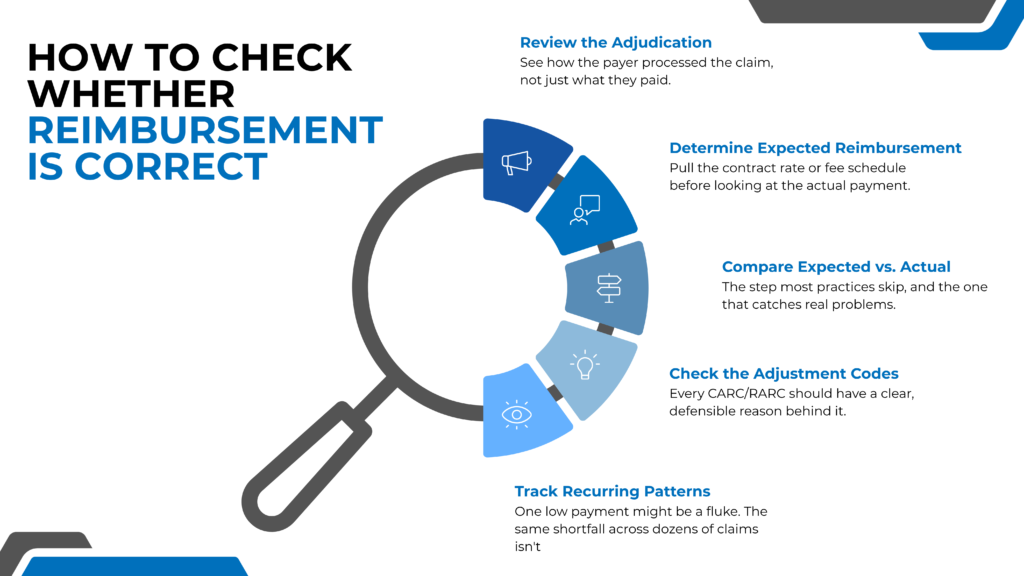
This is the part that actually protects your revenue. It takes a consistent process, not guesswork.
Start by reviewing adjudication. Look at how the payer processed the claim, not just what they paid.
Determine expected reimbursement. Pull the applicable contract rate or fee schedule amount before you look at the actual payment.
Compare expected versus actual payment. This is the step most practices skip entirely, and it’s the one that catches real problems.
Review the adjustments. Every CARC and RARC code on the remittance advice should have a clear, defensible reason.
Investigate unexplained variances. If a payment doesn’t match the expected reimbursement and no adjustment explains the discrepancy, that claim needs a call to the payer.
Look for recurring patterns; a single low payment could be nothing more than a coincidence, but the same shortfall appearing in dozens of claims indicates a systemic problem that should lead to escalation.
Building this into your routine, not just your EOB in medical billing review, but your full remittance process, turns payment posting into an actual accuracy check.
Don’t Stop at “Paid”
An EOB in medical billing can show that a payer processed a claim and issued payment. But payment status alone does not confirm payment accuracy.
Practices should understand what the payer allowed, adjusted, assigned to the patient, and ultimately paid.
More importantly, they should compare those amounts with expected reimbursement.
A stronger revenue cycle does not simply track whether payments arrive. It helps practices understand whether those payments align with what they should receive.
MedBill RCM helps healthcare practices strengthen revenue cycle visibility, identify reimbursement variances, and pursue the revenue they have earned.
Frequently Asked Questions
What is EOB in medical billing?
EOB in medical billing refers to the Explanation of Benefits that describes how a health insurer processed a claim.
It commonly shows charges, allowed amounts, insurer payments, adjustments, and patient responsibility. An EOB helps explain claim adjudication, but it is not itself a medical bill.
Is an EOB a bill?
No. An EOB explains how the insurance company processed a healthcare claim and allocated financial responsibility.
CMS distinguishes an EOB from a bill. Patients may receive a separate bill from their healthcare provider.
Does an EOB show how much insurance actually paid?
An EOB in medical billing generally includes the amount the insurer paid, the allowed charges, and the patient responsibility.
Providers may also review ERA or other remittance information for more detailed payment, adjustment, and adjudication information.
How can a medical practice tell if a claim was paid correctly?
Compare actual payment with expected reimbursement, rather than comparing payment only to billed charges.
Review applicable reimbursement terms, allowed amounts, patient responsibility, adjustments, and remittance information before determining whether a payment variance requires follow-up.