
Table of Contents
ToggleInsurance eligibility verification is increasingly important in the healthcare revenue cycle and it’s becoming more integrated and automated each year.
Despite all that, many of the practices still come up against coverage gaps and authorisation problems after they’ve provided the care.
Imagine a patient who has active insurance but has no authorisation for the procedure they’ve got scheduled.
Or imagine a patient who hands over their old coverage details. The problem only surfaces once the claim has been submitted.
Both scenarios result in a delay in reimbursement, an increase in admin work and leave the patient with all sorts of questions as to what they’re actually going to be charged.
New eligibility and authorization tools enable practices to identify these issues earlier.
They assist the clinical team with pulling in payer information, identifying missing requirements, tracking authorisations and getting the claims prepared more efficiently.
Not every tool has the same capabilities after all and automation in no way guarantees payment.
Knowing which technology solves which billing problem enables the practice to make better operational decisions.
Why Billing Delays Often Begin Before Claim Submission
Healthcare organisations frequently point the finger at coding errors, claim denials and slow payer processing as the cause of billing delays.
But the problems usually kick in much earlier actually. They kick in at scheduling, at patient registration, at insurance eligibility and at authorisation.
Consider a patient who books an outpatient imaging procedure.
The practice has active coverage but is missing the required prior auth. The claim is denied by the payer after treatment as the prior auth is still outstanding.
Now the billing department have to look at the denial, contact the payer and check the documentation. They then have to determine whether an appeal or some other form of correction is possible.
All that work can delay the reimbursement and increase the cost of managing the claim.
A better approach is to incorporate insurance eligibility verification into the authorization management process prior to the date of service.
Rather than waiting for billing issues to arise, practices can use technology to flag the exceptions as they happen so that their teams still have the opportunity to deal with them.
5 Eligibility and Authorization Tools That Could Help Prevent Billing Delays
Healthcare organizations can use a number of technologies to improve performance in the front end of the revenue cycle.
Some tools are based on existing e-commerce transactions. Others incorporate a higher degree of automation, intelligent document processing and/or emerging levels of interoperability.
The five categories below each deal with a different admin issue.
1. Real-Time Insurance Eligibility Verification Tools
The problem: Staff discover inactive coverage, incorrect insurance details, or benefit discrepancies after they provide services.
Real time insurance eligibility verification tools allow the healthcare organization to electronically request the available coverage information.
These systems commonly use HIPAA-standard 270 eligibility inquiries and 271 responses to exchange information with participating payers.
For example the CMS HIPAA Eligibility Transaction System enables real time Medicare eligibility inquiries via secure electronic transactions.
Depending on the payer and response, the information may include coverage status, plan details, deductibles, copayments, and other available benefits.
How the tool helps: A front-desk employee checks a patient’s coverage before an appointment.
The response shows that the policy information needs further review. Staff contacts the patient or payer before the visit.
This initial step can prevent the practice from submitting a claim with out of date coverage details.
Potential billing benefit: Fewer unresolved registration discrepancies and earlier detection of coverage problems.
A real time transaction doesn’t guarantee that every payer record will reflect the coverage change straight away.
2. Automated Benefits Verification Platforms
The problem: Staff repeatedly open payer portals and manually review benefit information for scheduled patients.
Automated benefits verification platforms extend insurance eligibility verification beyond individual coverage inquiries.
Depending on the product, these platforms can be used to trigger checks within the scheduling workflow, to collate payer responses and to flag records that need to be looked at.
Some medical insurance eligibility verification software also repeats checks as appointments approach.
How the tool helps: A multispecialty practice schedules several patients for procedures that need different benefit reviews.
The platform pulls the available insurance info and flags any cases that have missing or inconsistent details.
Staff are focused on the exceptions rather than re-running every single verification task by hand.
This can reduce admin load and improve consistency across sites.
Potential billing benefit: Earlier detection of benefit questions and fewer last-minute registration problems.
Practices must still confirm service-specific limitations, patient responsibilities, and any information that electronic responses leave out.
3. Prior Authorization Requirement Detection Tools
The problem: A practice confirms active insurance coverage but overlooks an authorization requirement for the planned service.
Insurance eligibility verification will not necessarily tell you whether or not the payer requires prior authorisation.
Authorization requirement detection tools allow an organization to compare the services they intend to deliver against the actual requirements of the payers.
Depending on the technology they may be used to weigh procedure codes, diagnosis information, payer rules and patient coverage details.
How the tool helps: A provider schedules an advanced diagnostic procedure.
The detection workflow flags a possible payer requirement before the appointment. An authorization specialist reviews the requirement and confirms the necessary documentation.
The team can then start the authorization process before treatment, instead of discovering the issue during claim review.
Potential billing benefit: Fewer overlooked authorization requirements and better preparation for scheduled services.
These tools are reliant on accurate payer details and reliable rule updates. Staff should check the requirements if the information appears to be incomplete or in any way uncertain.
4. Electronic Prior Authorization and Status Tracking Tools
The problem: Authorization requests travel through separate portals, phone calls, faxes, and manual follow-up lists.
Electronic prior auth tools will help you to manage the submission of requests, the documentation, communication with the payer and the monitoring of status.
Capabilities vary by vendor, payer, and integration.
Some systems will allow you to make electronic requests and responses. Others are primarily workflow management and tracking systems.
How the tool helps: An authorization specialist submits a request for a scheduled procedure.
The tracking system records the request and shows which payer responses remain outstanding.
If the payer asks for any further clinical information the workflow will alert the appropriate team. Staff can respond prior to the appointment if they are able to do so within the timeline.
Potential billing benefit: Better visibility into pending requests and fewer authorization cases that slip between departments.
Prior authorization automation can improve the admin side of things, but it can’t force the payer to authorise the service.
5. AI-Assisted Authorization Documentation Tools
The problem: Authorization teams spend significant time locating clinical notes, organizing records, and finding missing supporting information.
AI assisted documentation tools will help staff to pull the relevant information from the records that are available and structure that for the authorisation review.
Depending on the system they may be used to identify missing fields, to summarise the documentation or to prepare the information for staff to check.
These capabilities represent an emerging area of revenue cycle automation.
How the tool helps: A practice prepares an authorization request that needs clinical history, diagnosis information, and supporting treatment records.
An AI assisted workflow identifies potentially relevant documents and flags the missing information.
Clinical and authorization staff review the material before they submit it.
This could reduce the amount of repetitive document preparation and help teams to submit more complete requests.
Potential billing benefit: Less manual document handling and fewer avoidable requests for missing information.
However AI generated summaries can be wrong and can miss the important clinical context.
Organizations must maintain privacy safeguards, validate the outputs, and require qualified staff to review clinical documentation.
Which Tool Addresses Which Billing Problem?
Each technology serves a different purpose.
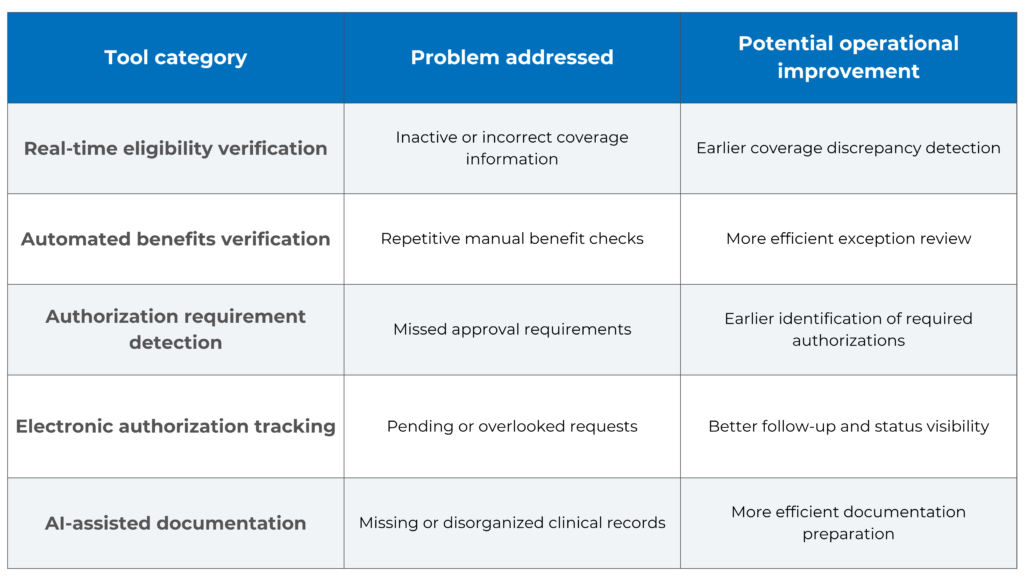
Practices should choose tools based on their existing workflow problems. No single platform fixes every billing delay.
How Eligibility and Authorization Tools Work Together
The biggest opportunity is in linking insurance eligibility verification with authorisation review and billing preparation.
Consider a specialty clinic that prepares for a scheduled procedure.
Step 1: Verify coverage
The scheduling system commences with an insurance eligibility check using the insurance information that is available on the patient’s file.
Staff review the response and investigate any discrepancies.
Step 2: Review benefits
The benefits verification workflow pulls in the available information on coverage terms and patient responsibilities.
Staff confirms details that need additional payer review.
Step 3: Identify authorization requirements
The authorization detection tool evaluates the planned service against available payer requirements.
An authorization specialist will confirm whether or not the payer needs approval.
Step 4: Submit and track the request
If authorization is required from the payer then the staff will prepare the relevant documentation and submit the request via one of the available channels.
The tracking system highlights pending decisions and follow-up tasks.
Step 5: Review billing readiness
Prior to submitting a claim the billing team will verify the patient details, coding, documentation and authorization details.
This connected workflow helps staff solve administrative issues before they cause downstream claim complications.
Insurance eligibility is still the starting point, but you then need to do separate checks on authorization and claim readiness.
What’s Changing for Prior Authorization in 2026 and 2027?
Federal interoperability requirements are creating new opportunities for electronic authorization workflows.
The CMS Interoperability and Prior Authorization Final Rule (CMS-0057-F) brings about operational changes commencing in 2026. The API requirements generally commence in 2027.
Faster Prior Authorization Decisions in 2026
Under the rule, affected payers, excluding certain Qualified Health Plan issuers, generally must issue decisions within:
- 72 hours for expedited requests.
- 7 calendar days for standard requests.
Applicable extensions and program-specific exceptions may affect these timelines.
These requirements cover specific medical items and services. They do not cover prior authorization decisions for drugs.
Affected payers must also provide specific reasons for denying an applicable authorization request.
This helps the clinical team to understand why the payer has made their decision and whether they need to provide further documentation or go ahead and appeal.
Electronic Prior Authorization APIs in 2027
Beginning in 2027, affected payers must implement certain standardized APIs. Compliance dates vary by payer type.
The Prior Authorization API must support information about authorization requirements, documentation, requests, and responses.
These developments enabled compatible systems to exchange information more efficiently.
However the practices should be able to differentiate the forthcoming regulatory requirements from the capabilities that their current payers and vendors already have.
What These Changes Mean for Healthcare Practices
The regulatory changes strengthen the case for evaluating electronic authorization capabilities.
Healthcare organizations should review their existing software, payer connections, and authorization processes before they adopt additional technology.
A platform which supports e-submission may still require manual follow up for payers that don’t have the appropriate integration.
The objective should be measurable workflow improvement, not automation for its own sake.
What Eligibility and Authorization Automation Cannot Prevent
Even advanced insurance eligibility verification software cannot eliminate every billing problem.
An eligibility response may confirm active coverage without proving that the payer will cover a particular service.
Likewise, an approved authorization does not guarantee reimbursement.
Payers can still apply coding requirements, coverage limitations, medical necessity policies and all other claim adjudication rules.
Automation also depends on the quality of the information it receives.
Wrong patient demographics, out of date payer requirements, incomplete clinical documentation and poorly configured integrations can all give rise to further admin issues.
AI-assisted tools add further considerations, including accuracy, explainability, data privacy, and appropriate human oversight.
Healthcare organizations should evaluate these limitations before they rely on automated outputs.
How Healthcare Practices Can Evaluate the Right Tools
The most effective technology investment starts with finding the source of existing billing delays.
Practices should look at whether the problems arise at registration, benefits verification, authorisation review or claim preparation.
Start With Denial and Exception Data
Review recent claims to identify recurring eligibility-related and authorization-related problems.
Compare the denial patterns with the registration errors, missing approvals and the outstanding documentation requests.
This analysis shows which tool category meets the greatest operational need.
Evaluate Integration and Payer Coverage
Not every insurance eligibility verification software platform is going to be able to connect to every payer or practice management system.
Confirm supported transactions, payer connections, EHR compatibility and exception handling.
Ask the vendors how their product deals with the scenario of an incomplete response and/or unavailable payer information.
Define Staff Responsibilities
Automation should make responsibility clearer, not hide it.
Registration teams can deal with coverage discrepancies, authorisation specialists can deal with authorisation requests and the clinical teams can look at the supporting documentation.
Every unresolved issue needs an owner and a follow-up process.
Measure Operational Performance
Organizations should track practical indicators before and after implementation.
Useful metrics would be the eligibility exception rate, authorisation turnaround times, number of outstanding requests, staff follow up load and preventable denial trends.
These help the practice to assess whether the technology has any impact on performance.
Any organisation looking at insurance eligibility verification services should also look at the vendor’s reporting, their escalation process and how well they co-operate with their internal billing teams.
Building a More Reliable Revenue Cycle Starts Before Billing
Insurance eligibility verification and prior authorization technology can help healthcare practices identify administrative problems earlier, reduce repetitive tasks, and improve visibility across pre-service workflows.
Real-time verification, automated benefits review, authorization detection, electronic tracking, and AI-assisted documentation each address different sources of delay.
However, successful implementation requires more than purchasing software.
Healthcare organizations need accurate data, dependable integrations, clear staff responsibilities, and consistent performance monitoring.
As payer interoperability requirements continue to evolve, practices that strengthen these processes can better prepare for more connected revenue cycle operations.
MedBill RCM supports healthcare organizations with medical billing and revenue cycle management services that aim to improve billing workflows and address reimbursement challenges.
Better billing performance begins with the information and decisions that come before the claim.
Frequently Asked Questions
How Do Healthcare Providers Verify Insurance Eligibility and Benefits?
Healthcare providers check available coverage and benefit information via payer portals, electronic eligibility transactions or insurance eligibility verification software that is connected to their system.
Staff should look at the variances and confirm the service specific requirements prior to treatment.
How Can Practices Check Patient Insurance Eligibility Before Appointments?
Practices can run insurance eligibility verification during scheduling and repeat checks closer to the appointment when appropriate.
Automated tools can flag records that need staff review before the patient arrives.
What Is Insurance Eligibility Verification?
Insurance eligibility verification confirms the information available regarding a patient’s insurance coverage and benefits.
It helps practices identify potential coverage issues, but it does not guarantee reimbursement for a particular service.
How Can Prior Authorization Automation Help Prevent Billing Delays?
Prior authorization automation can identify approval requirements, organize documentation, track requests, and highlight pending payer decisions.
These capabilities help practices address authorization issues earlier, although payer approval and payment remain separate decisions.
Does Insurance Eligibility Verification Confirm Prior Authorization?
No. Insurance eligibility verification checks available coverage information, while prior authorization addresses advance payer approval requirements for specific services.
Practices must review both processes when they apply.