
Table of Contents
ToggleRevenue cycle management automation can assist home health and hospice agencies in identifying documentation gaps, organising their billing work, and reducing repetitive administrative tasks. An unfinished claim for the owner means delayed cash flow. For the nurse, it may just be another clarification request after a long day of visits. For a biller, it often means going through the chart and then chasing a number of people before the claim gets anywhere. AI could help teams find these problems earlier. The benefit depends on accurate findings, clear responsibilities, and a workflow that staff can actually use.
Here’s where automation may be of use, what should remain the domain of professional review, and how to pick a practical starting point.
What revenue cycle management automation actually does
The revenue cycle is the process that links intake, eligibility verification, clinical documentation, coding, claim submission, payment posting, and collections.
Traditional automation handles repeatable steps using predefined rules. It can flag a missing document, assign follow-up, or remind staff about a deadline.
AI in the revenue cycle supports processing clinical text, identifying historical patterns, and disseminating information across multiple records.
Language processing may bring to light conflicting documentation. Predictive models may flag claims for review. Generative AI may be used to produce a summary of a payer’s response.
These capabilities require different controls. A deadline reminder requires a precise rule. An AI-generated summary requires a comparison to the source.
Agencies should focus on the product’s specific function rather than assuming every automated feature is AI.
Why home health and hospice need separate workflows
Home health revenue cycle management depends on coordination between intake staff, field clinicians, ordering practitioners, coders, and billers.
Assessments, orders, and diagnosis documentation all contribute to billing readiness. The Medicare home health payment is based on the Patient Driven Groupings Model (PDGM).
Hospice teams manage the election records, terminal illness certificates, notices, and all the documentation that supports the hospice care.
A workflow built for one service may well be missing the key requirements of the other.
Agencies providing both services should evaluate each separately, including document requirements, deadlines, task ownership, and escalation procedures.
Where AI could help Home Health Agencies
1. Review OASIS inconsistencies
The Outcome and Assessment Information Set (OASIS) is the set of standardised assessment data. OASIS-E2 is effective 1 April 2026 per CMS.
AI-assisted tools could compare assessment responses with relevant clinical notes and flag apparent inconsistencies.
Illustrative example: A visit note refers to mobility limitations which don’t appear to be consistent with the assessment response.
The system highlights both entries and routes the question to the responsible clinician.
The clinician checks whether the records describe the same assessment timeframe and circumstances, then determines whether clarification or correction is appropriate.
This context matters. Different findings do not automatically mean someone made an error.
Support diagnosis coding review
AI medical billing software can identify documented conditions and surface the relevant supporting passages for the coder.
The coder goes through the documentation, applies the current coding guidelines, and confirms which codes are appropriate.
Useful recommendations will tell you where the information originated from. Unsubstantiated suggestions, on the other hand, create extra work for you and can potentially lead to billing errors.
Agencies should also be checking that the payment configurations are still up to date. It’s of no use having consistent processing if the rules underneath are out of date.
2. Reduce missing-order follow-up
Missing or incomplete orders can leave staff confused about who should act.
Illustrative example: During claim preparation, a system flags an order that appears incomplete and links to the document.
The designated coordinator checks whether a completed version already exists. If further action is needed, the coordinator follows the agency’s established process.
Unresolved clinical questions go to the appropriate professional. The biller receives confirmation once the issue has been reviewed and resolved.
Recording that history helps prevent several employees from sending the same request.
Where Hospice Agencies could benefit
1. Review admission and election records
Hospice admission information can be found in various documents and systems.
AI-assisted review could flag inconsistent dates, missing fields, and records that need closer review.
Illustrative example: Two admission documents show different election dates.
The system directs the admissions reviewer to both records. The reviewer establishes the facts and arranges for any necessary correction.
The billing team receives confirmation and can see who completed the review.
Finding a discrepancy is only the first step. The workflow must help someone resolve it.
2. Track notices and certifications
Automation can maintain separate tasks for notices, certification records, and other admission requirements.
For Medicare hospice, CMS states that the Notice of Election must be filed within five calendar days after the election date.
A good system will track submissions, flag any outstanding issues, and escalate approaching deadlines.
Document review may help locate certification records or flag incomplete fields. Authorized professionals remain responsible for clinical certification and eligibility determinations.
3. Monitor election statement addenda
From 1 October 2026, CMS will require a written election statement addendum for each hospice election.
The addendum addresses specified noncovered items and services and explains appeal rights. CMS announced enforcement discretion through 31 December 2026.
That discretion does not in any way remove the furnishing requirement.
Agencies should set up tracking in accordance with the current instructions, assign ownership, and keep evidence that the required actions have in fact taken place.
Generating a form alone doesn’t establish that the content is correct or that the delivery requirements have been met.
What should your agency automate first?
Start with a problem that recurs and has a clear owner and a measurable outcome.
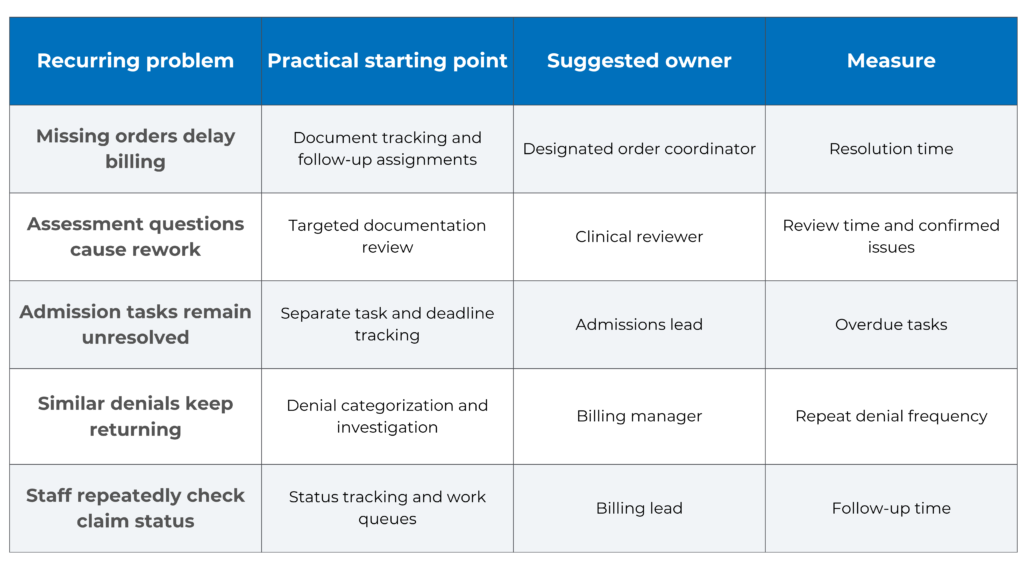
Adapt ownership to your staffing structure. One person may handle several functions in a smaller agency.
Start with reliable workflow automation where it actually solves the problem. Add in AI when it’s going to provide some benefit in terms of interpretation or pattern recognition that’s worth investigating.
Make the workflow easier for workers
An alert should tell the staff what needs to be reviewed, where the evidence is located, and who is responsible for the next action.
Clinicians need specific questions rather than broad requests to “fix documentation.”
Billers need to know the status and resolution history. Coordinators need to be able to see the history of prior outreach so they don’t end up making duplicate requests.
Give staff a way to dismiss incorrect alerts and explain why. Managers should review recurring false warnings with the vendor.
Agree on escalation procedures for unresolved issues and approaching deadlines.
Ask frontline workers whether the system reduces searching, repeated messages, and unnecessary interruptions. Their experience belongs alongside financial measures.
Use denial patterns to improve the process
AI assisted analytics can group the claim problems by payer, denial reason, documentation issue or workflow stage.
That can help managers investigate where repeated rework begins.
For instance, repeated documentation denials may indicate a poor handoff before the claim is submitted. Fixing that handoff may be the answer rather than simply adding more follow-up reminders.
Verify findings against actual claims and payer responses before changing procedures.
Keep the clearinghouse rejections separate from the payer denials. If you combine them, you’re effectively hiding whether the issue occurs before payer acceptance or during adjudication.
Assign an owner to each corrective action and check whether the same issue becomes less frequent.
Questions to ask an AI billing software vendor
Ask the vendor to demonstrate your agency’s difficult cases, including incomplete information and incorrect recommendations.
Use these questions during the review:
- Does the product support home health, hospice, or both?
- Which features use fixed rules, and which use AI?
- Can staff trace findings to original records?
- How does the product connect with existing systems?
- Who maintains payer rules and payment configurations?
- Can reviewers correct outputs and preserve decision history?
- How does the vendor protect, retain, and use patient information?
- Does the vendor use agency data to train models?
- What setup, training, integration, and ongoing fees apply?
- Can the agency export its data and review history?
Include clinical, coding, billing, and privacy staff. Their questions will reveal different strengths and limitations.
Review your applicable HIPAA obligations and your contractual arrangements prior to introducing any protected health information.
Measure value before expanding
Record baseline performance before the pilot begins.
Track documentation resolution time, claim submission delays, rejection rates, denial rates, and days in accounts receivable.
Also measure staff review time, false alerts, missed issues, and corrections to AI outputs.
Use representative records, including difficult cases. Keep definitions consistent and account for changes in staffing, volume, and payer mix.
For a basic labor estimate, multiply verified hours saved by the relevant hourly labor cost.
Treat this as released capacity unless expenses actually fall. Time saved does not automatically become cash savings.
Likewise, faster collections can improve cash flow without increasing total revenue.
Include setup, integration, training, ongoing review, and error correction when comparing benefits with costs.
Expand when results justify the investment and staff can reliably manage the workflow.
Keep professional accountability clear
AI generated summaries and code suggestions can be very convincing in their output, whilst completely omitting context and/or introducing information that isn’t actually there.
A GAO report on medical notes and coding points to accuracy issues, a lack of evidence of performance, and some potential benefits.
Define who approves coding changes, documentation corrections, and payer correspondence.
Preserve the original records and the history of the review. Clinical decisions (including homebound status and terminal illness eligibility) are the domain of the qualified professional.
Start with the problem that keeps returning
Revenue cycle management automation is most effective when it can link a confirmed issue to the appropriate person and a clear next step.
AI in healthcare revenue cycle management can support that process through text review, coding assistance, and pattern analysis. Each capability needs testing against real agency work.
Choose one recurring bottleneck, involve the staff who handle it, and measure the results before expanding.
MedBILL RCM supports healthcare providers with medical billing and revenue cycle management services. Contact the team to discuss your agency’s documentation, billing, and reimbursement challenges.
Frequently Asked Questions
How can AI improve revenue cycle management in healthcare?
AI supports revenue cycle management automation through documentation review, coding assistance, denial analytics, and workflow prioritization.
Organizations must validate outputs and keep human oversight.
How is AI used in home health and hospice revenue cycle management?
Home health agencies may use AI to review OASIS data, coding, and claim readiness.
Hospices may use it to monitor documentation, deadlines, and denial patterns.
How does AI help reduce billing and coding errors?
AI can flag mismatches between documentation and billing data, find missing fields, and suggest codes for review.
It can also make errors, so qualified staff must verify results.
Can AI replace medical billing and coding professionals?
No evidence supports full replacement. AI can automate some administrative tasks.
Regulatory interpretation, clinical judgment, and billing accountability still need qualified professionals.
What are the risks of AI in revenue cycle management?
Key risks include inaccurate outputs, unsupported codes, privacy exposure, biased predictions, and overreliance on automation.
Agencies should assess accuracy, security, transparency, and oversight first.